Author: Technical

  • Structural Adhesives Ltd in the Leicester Mercury

    The Leicester Mercury has today published an article about the work being carried out at Structural Adhesives Ltd including the green agenda, the development of the new A2 fire-rated adhesive and collaboration with local universities.

    Follow the link to find out more and to see what our director has to say.

    https://www.leicestermercury.co.uk/special-features/female-team-chemists-stick-strategy-5245362

  • Finalists of the Midlands Innovation of the Year Award

    We have been shortlisted as finalists of the Midlands Innovation of the Year Award at the Midlands Business Awards 2021 for our A2 Fire Rated Epoxy Adhesive.

    The Midlands Business Awards celebrates the finest business talent the Midlands has to offer. From manufacturers, service providers to universities and young entrepreneurs, the Midlands Business awards recognizes the best business minds in 13 different categories.

    The Midlands Business Awards winners will be announced at a Gala dinner later this year so keep tuned to find out the results.

  • Excellence in Innovation: Structural Adhesives Ltd Wins at Leicestershire Business Awards

    Winner of Innovation in Construction

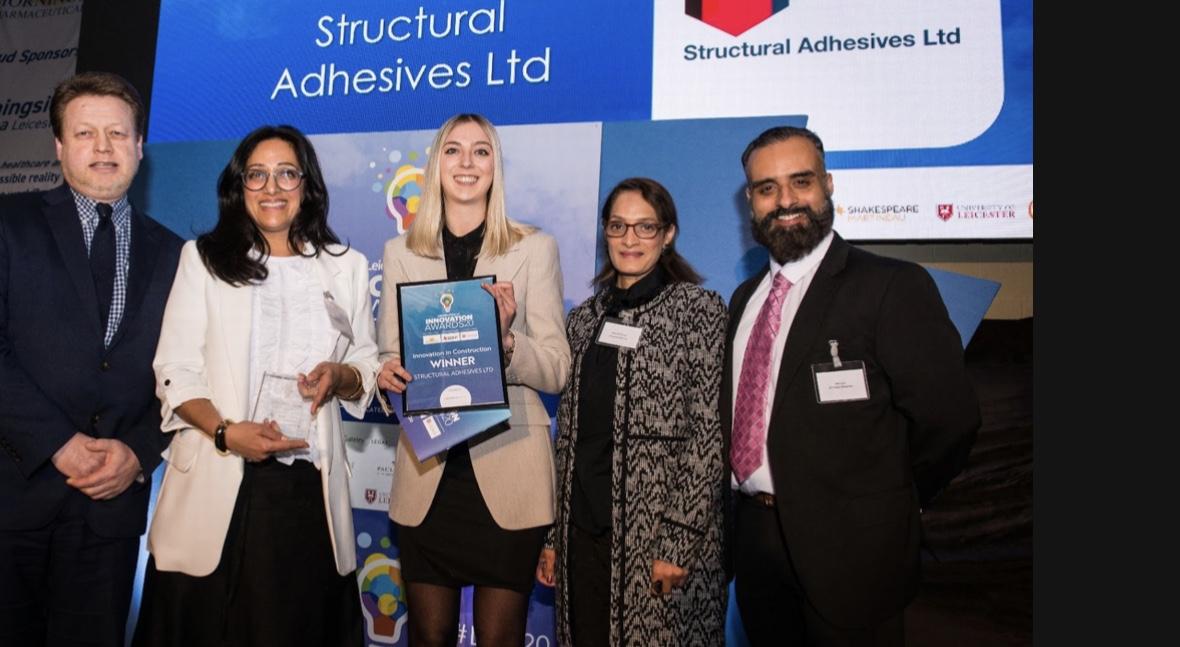
    We’re proud to announce that Structural Adhesives Ltd was named winner of the Innovation in Construction category at the 2020 LeicestershireLive Innovation Awards.

    As a small Leicester-based company with a big vision, this award reflects our commitment to solving real-world challenges through research, development, and manufacturing – all from the heart of England.

    Our winning innovation, S-2825FRE, is the UK’s first independently certified limited combustibility adhesive for use on external walls of high-rise buildings. Developed in response to the December 2018 legislation banning combustible materials on buildings over 18 m, this product offers a lifeline to construction firms navigating the new fire safety landscape.

    While multinational companies poured resources into similar projects, it was our compact R&D team, two female chemists led by a female MD, who delivered the breakthrough. Their dedication and technical ingenuity resulted in a product that meets A2-s1, d0 fire rating standards without compromising on performance.

    Winning the Innovation in Construction award affirms our belief that small businesses can lead the way in sector transformation. We’re proud to be part of Leicestershire’s thriving innovation community and even prouder to help shape the future of safe, sustainable construction.

    Congratulations to our team!

  • Fire safety regulation enforcement in the construction industry

    As we launch our A2 fire rated epoxy adhesive we at Structural Adhesives ltd are thinking more deeply about the statutes that surround the use of products such as this and how the use is governed.

    In the case of A2 rated non-substantial components of a system the rating strictly depends on the application rate of the non-substantial component. A product will have been tested at a stipulated application rate and determined to have limited combustibility. If twice the amount of product were used, the amount of fuel present to burn would be double and hence the reaction to fire would be significantly increased. Using an A2 rated non-substantial component at above the tested application rate is not compliant to regulations.

    As the application rate is of paramount importance who is held responsible for ensuring the correct amount is used every time? Simply, all interested parties have some moral responsibility regarding the use of the product. The manufacturers of said A2 non-substantial components have a duty to provide all relevant information and make it clear to their customers that the product is only compliant when used at the correct application rate. Their customers, for example cladding manufacturers, are then responsible for ensuring this application rate is strictly adhered to, making sure all employees using the non-substantial component are aware. The designers and architects of the building should have thoroughly researched and asked questions about the specified products to ensure they are compliant with regulations and measures are in place to ensure that the systems continue to be manufactured accordingly.

    In a perfect world this communication should be sufficient to ensure that all materials that end up on high rise buildings are safe and compliant. Unfortunately, this may not always be the case due to error or negligence. For example, a warehouse employee with no knowledge of fire regulations may apply 550 g of a product rather than 500 g thinking it will not matter. There are ways to reduce this risk such as using machines to apply the exact amount of product required, or stressing the importance of the application rate but even this is not fool proof. Also, in every industry there are those that are less than honorable and will cut corners to save time or money or sell a product that may not be entirely fit-for-purpose. Policing is required to make sure that buildings are being constructed to the letter of the law but who carries out this policing?

    An enforcement body is needed to monitor regulatory compliance and to administer consequences when there is a lapse. It would be impossible for an enforcement body to monitor every item produced by a manufacturer but it would be possible to carry out surprise audits- a sort of Ofsted for the construction industry.

    Morally the responsibility is shared amongst many, but if a building was randomly assessed and deemed non-compliant due to incorrect use of a A2 non-substantial component who would legally be blamed for this? Where does the accountability lie? The UK government is proposing a system of duty holders with responsibilities at certain stages of construction. More clarification of how duty holders are to be appointed is required but this proposal may go some of the way to resolving the seemingly ambiguous nature of responsibility in the construction industry.   

  • Biobased Adhesives: is it a question of environmental cost vs financial cost?

    Increased cost is one of the barriers to launching biobased adhesives and this is something the team here at Structural Adhesives Ltd have been discussing recently. Currently, biobased polymers are slightly more expensive than their petrochemical counterparts and so the questions many manufacturers are facing is ‘will my customers be willing to pay a bit more for a product that has a lower carbon footprint?’. For some customers the answer is a quick no. Other customers, usually the ones with sustainability and environmental impact at the very heart of their company policies are more open to consideration.

    We are starting to see a shift in tide, the proportion of customers falling into the second category is swiftly rising. With the UK announcing a target of net zero greenhouse gas emissions by 2050 many businesses are following suit and setting targets of their own in-line with the government legislation. Switching to more biobased products is one such way in which business could reduce their carbon emissions and meet their sustainability targets. As well as meeting internal targets it is likely that as we draw closer to 2050 the government will introduce incentives for business to reduce emissions. This could come in one of many forms such as introducing tax relief on ‘greener products’ which would make biobased products more attractive commercially. 

    Converting renewable plant matter into biobased polymers for adhesives involves complex processes and has a higher production cost, this is the main reason that petrochemical based adhesives offer a slight cost saving present. However, biopolymer production is still a relatively new industry and advances in efficiency are being made rapidly, thus production cost is beginning to decrease.  Furthermore, the price of petroleum is already subject to sudden and dramatic changes which is of great disadvantage to businesses and this situation will only become worse as the supply of available fossil fuels decreases. Many are predicting that we are nearing the stage where biobased adhesives will be as economically viable as petrochemical adhesives if not more so. 

    Next post in this series

  • Failure mechanisms of mechanical fixings

    Defects or irregularities in structural materials such as holes, sharp corners, notches and grooves disrupt the flow of stress and cause areas where the stress is considerably higher than the surrounding areas. [1] These are known as stress concentrations, stress raisers or stress risers. Such irregularities in materials may occur naturally or as a result of manufacturing procedures however, they may also be created intentionally for the purpose of using mechanical fixings such as screws and bolts to join materials together. Fatigue cracks are generally initiated at stress concentrations (such as those from mechanical fixings) when the mechanical stress on the material is not constant but changes in direction and magnitude.[2] After initiation, the fatigue crack will propagate a little with every load cycle. Once the crack has grown to a critical limit the crack will then propagate more quickly and will eventually result in complete failure.[3]

    As well as forming at stress concentrations, cracks can also form in structural materials from corrosion, this is known as stress corrosion cracking. Generally mechanical fixings are made of metal or metal alloys and hence can be susceptible to corrosion and stress corrosion cracking. Several mechanisms for initiation of stress corrosion cracking have been suggested. One such mechanism is the rupture of the oxide film which leads to pitting.[4] Pitting initiates crack formation as hydrolysis reactions cause the levels of corrodent in the pits to be significantly higher than the bulk of the material and this creates a climate favourable for crack formation. Furthermore, when metals are joined by metallic mechanical fixings, galvanic corrosion can sometimes occur. Galvanic corrosion occurs when a metal is in contact with a different metal in the presence of an electrolyte.[5] Due to the difference in potential of the two metals current flows between them and consequently corrosion occurs at the metal that is considered the anode.

    Joining dissimilar materials improves design flexibility and allows the specific properties of each material to be used in conjunction.[6] However, dissimilar materials expand and contract at different rates with temperature changes. If mechanical fixings are used to join dissimilar materials the clamping force on the materials and the tension in the mechanical fixing will change as the temperature changes.[7] Inappropriate clamping force can lead to breaking of the mechanical fixing or elimination of tension, also known as stress relaxation can occur.

    Some manufacturers are taking precautions to limit the risks of failure occurring by the previously discussed methods. One such measure that is becoming popular is combining mechanical fixings with adhesive bonding. Using two or more joining techniques is known as hybrid bonding and there are studies to suggest that this can lead to improved fatigue, strength and stiffness.[8],[9] In hybrid joining, adhesives are particularly used at stress concentrations to enhance joints and reduce fatigue cracking.[10]


    [1] P G Forrest, Fatigue of metals, Pergamon Press Ltd., Oxford, 1, 1962, Chp. 1, pp 1-2

    [2] G.A. Lange, in Encyclopedia of Materials: Science and Technology, ed. K.H. Jürgen Buschow, Robert W. Cahn, Merton C. Flemings, Bernhard Ilschner, Edward J. Kramer, Subhash Mahajan and Patrick Veyssière, , Elsevier, Amsterdam, 2nd edn, 2001, pp 3265-3270,

    [3] J.K. Lim, in Stress Corrosion Cracking; Woodhead publishing series in metals and surface engineering, ed. V.S. Raja and T. Shoji, Woodhead Publishing, Cambridge, 2011, pp. 485-536

    [4] B.F. Brown, Stress-corrosion cracking in high strength steels and in titanium and aluminium alloys,Naval research laboratory; [for sale by the Supt. Of Docs., U.S. Govt. Print. Off.], Washington, 1972

    [5] X.G. Zhang, in Uhlig’s Corrosion Handbook, e.d R. Winston Revie, John Wiley & Sons, Hobken, 3rd edn., 2011, ch.10, pp 123-143

    [6] P. Kah, R. Suoranta, J. Martikainen and C. Magnus, Rev. Adv. Mater. Sci., 2014, 36, 152-164

    [7] J. Bickford, An introduction to the design and behaviour of bolted joints, Revised and Expanded, Routledge, Boca Raton, 1995

    [8] F.M.De Wit and J.A. Poulis, in Advanced materials in Automotive engineering, ed. J. Rowe, Woodhead Publishging, Cambridge, 2012, ch. 12, pp 315-329

    [9] R. Matsuzaki, M. Shibata and A. Todoroki, Composites part A: Applied science and manufacturing, 2008, 39 (2), 154-163

    [10] I. Ashcroft and P. Briskham, in Advances in Structural Adhesive Bonding; in Woodhead Publishing series in Welding and other joining technologies, ed. D.A. Dillard, Woodhead Publishing, Cambridge, 2010, ch. 16, pp 469-515
  • Structural Adhesives Ltd.’s progressive social impact journey

    The sea change in worldwide attitudes towards how we impact on our surrounding community and the environment and has never been more relevant.  Manufacturing and in particular, the Chemicals Industries, have their part to play redressing the issue. Structural Adhesives Ltd is committed to sustainability, the environment and always seeking better solutions and this drives our business values. With the United Nations sustainable achievement goals in mind, for the past few years and months our team have been taking measures to improve our social impact.

    All manner of business areas can have an impact on the wider community. A particularly relevant area for our business is the use of energy and resources in the manufacture of our products and the impact of this on the climate. There is a carbon footprint for all manufactured items and this is inescapable. As well as the energy used in the production of a product itself, energy is used to extract, mine, grind and transport the raw materials. Structural Adhesives Ltd understands the processes involved in the manufacture and distribution of fillers and additives and chooses raw materials carefully when formulating to bear this in mind. Minimising our carbon footprint is of high priority at Structural Adhesives Ltd and we source locally where possible. As well as considering the environmental factors of our supply chain Structural Adhesives Ltd are also conscious of only working with suppliers that have first rate ethics policies.

    Often the raw materials that go into adhesives are from unsustainable resources such as fossil fuels, Structural Adhesives Ltd have been developing and formulating products with reduced amounts of these raw materials and are investigating alternatives such as biobased raw materials. Also, regular readers of the blog will already be aware of our constant research into reduction of plastic packaging and waste. In addition to actively reducing the impact of our processes on the environment, the technical team at Structural Adhesives Ltd are always looking for area’s in which we can use our knowledge to have a positive impact. This includes research into areas such as renewable energy and more environmentally friendly transportation that may require the use of adhesives.

    Alongside our environmental policies Structural Adhesives Ltd are starting to try to use our position to improve the community in our local area and also the wider scientific community.  Structural Adhesives Ltd is a female lead company that is very diverse and inclusive and we are seeking to improve opportunities for all and to promote STEM wherever possible. As part of the chemicals industry, we are well aware of the issues surrounding gender imbalance and diversity. Many of the industries we service including Aerospace, Engineering and Construction are heavily male dominated. Additionally, our MD has come from a teaching background and absolutely believes in the necessity of redressing the imbalance that currently exists in STEM. As a result, our MD and the all-female technical have all become Women in Construction Ambassadors and helped support and drive diversity and equality across the built environment. Furthermore, the technical team have spoken to both students and teachers at exhibitions about the vast range of career prospects in STEM particularly opportunities with small businesses like ours. Structural Adhesives Ltd have plans to participate in more outreach and community involvement programmes in the future.

  • Award Winning A2 Adhesive!

    We are thrilled to have won the Innovation in Construction Award at the LeicestershireLive Innovation Awards for our A2 Fire Rated Epoxy Adhesive.

  • East Midlands Chamber Enterprising Women Awards Finalists

    Structural Adhesives Ltd have been shortlisted for the East Midlands Chamber Enterprising Women Awards in the category of Outstanding Contribution to work in STEM sponsored by Pick Everard.

    Organised and facilitated by the East Midlands Chamber, Enterprising Women is a diverse and vibrant group. The Enterprising Women Awards is a fantastic opportunity to acknowledge the amazing work that women in the region undertake every day.

  • LeicestershireLive Innovation Award Winners

    Structural Adhesives Ltd are delighted to announce we have won the Innovation in Construction award at the LeicestershireLive Innovation Awards 2020.

    The LeicestershireLive Innovation Awards are hosted by the Leicester Mercury newspaper and the LeicestershireLive website. These awards are held to celebrate all things innovation throughout Leicestershire with the aim of showcasing all of the fantastic ideas and hard work that Leicestershire businesses have to offer.